The Complete Guide to Human Design Types for Career Decisions
Unless you’re one of the lucky ones, chances are you’ve found yourself Googling “why do I hate my job” at 11pm and fallen down the rabbit hole of personality tests, Myers-Briggs, & CliftonStrengths. Learning about yourself was probably great, but you likely still felt that itching sensation that that’s not all there is to the story. The problem with all of these systems is that they tell you about your traits - Not who you are. This is where Human Design changes the game - It’s not just a list of different qualities you have, it’s an operating manual for how to live your life.
What is Human Design?
Human Design combines astrology, the I Ching, Kabbalah, and the chakra system into a bodygraph calculated from your birth date, time, and location. And, listen - I’m a skeptic. I went to a research university. However, every time I share details of their bodygraph with my clients, they tell me it feels eerily accurate.
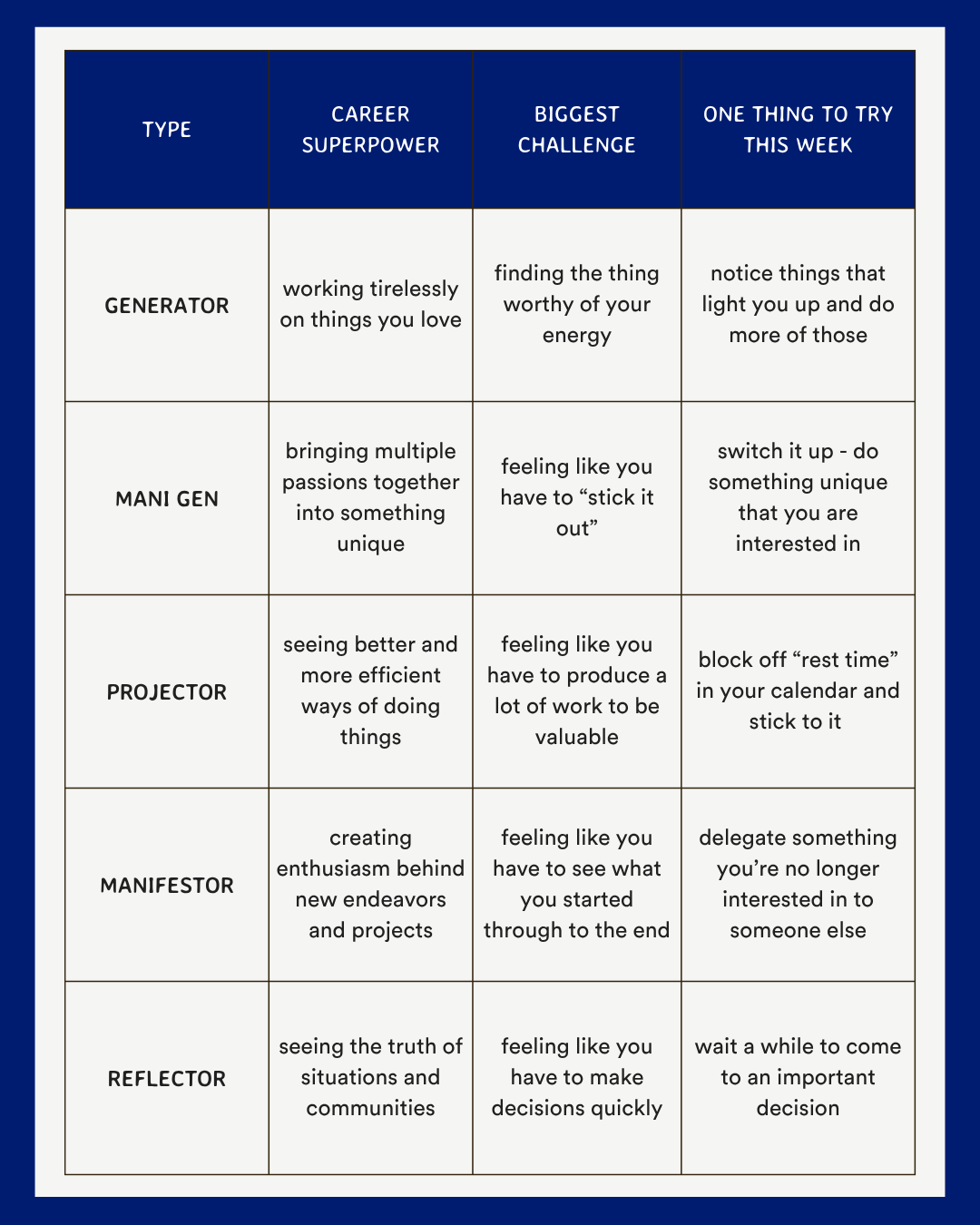
Within Human Design, there are a ton of different data points, but everyone falls within one of 5 energy types (Generator, Manifesting Generator, Projector, Manifestor, Reflector). Each type has a distinct strategy for how they are meant to operate in the world and specific emotional themes that let them know when they are on/off track for their purpose & destiny.
Generators
The world is largely built for Generator energy. If you’re a a Generator, you’re built for work that genuinely lights you up. You have a sustainable life-force energy that allows you to keep going like the Energizer bunny - but only when you’re responding to the right things. Many Generators experience burnout by forcing themselves into careers they chose with their heads instead of their gut. If you’re a generator and you’re feeling this way, try to slow down your decisions. Ask your gut “Do I really want to do this?” before committing. Your gut feelings will always lead you in the right direction.
Manifesting Generators
ManiGens are similar to Generators but are often passionate about many different things. Often ManiGens will have nonlinear career paths, which can be challenging in a world that often tells us that success comes from consistent effort in one area of life. Unfortunately, this nonlinear, multipassionate energy is often misread as scattered or inconsistent, leading to a resume that seems messy. ManiGens often experience burnout when they stay in roles that require them to do things one way, in a specific order, forever. If you’re a ManiGen, ask your boss for autonomy and variety. If you’re job searching, know that a "messy" career path is often the right one for you.
Projectors
Projectors are natural guides and strategists, but we are NOT built for the same output as Generators. In order for us to do our best work, we must first be recognized as a valuable resource and invited to share our thoughts and perspectives. We experience burnout (a lot) because we are often expected to work with the same tireless energy as the Generator types - When we’re not. If you’re a projector, combat burnout by positioning yourself as the expert in your area of interest, and wait for roles/opportunities that come with genuine buy-in from others.
Manifestors
These fire-starters are here to initiate and make things happen. Manifestors are independent, impact-oriented, and often misunderstood as "difficult”. They, too, are not built for the same output as Generators and can experience burnout from trying to do too much or see the tasks they initiated through to completion. If you’re a Manifestor, seek environments where you have real autonomy - Where you can inform others of your plan, rather than asking.
Reflectors
These babies are RARE (1% of population). Reflectors are deeply sensitive to their environment as they absorb and reflect the energy around them - This makes them fantastic members of any team as they will be able to truthfully reflect the health and energy of their teammates. However, they are often misunderstood as indecisive or lazy because their energy is often very low. If you’re a Reflector, know that the workplace culture will make or break your professional experience — choose accordingly, and build in decompression time for yourself.
Why Type Alone Isn't Enough
Ra Uru Hu (The Founder of Human Design) famously said that if all you know is your type, strategy, and authority, the rest of your chart will come into place naturally. While that’s true, understanding the other aspects of your chart - such as your profile and incarnation cross - can help you get much more clarity about the specific value you are meant to bring to the world and workforce. Most people try to use Human Design to create a list of job titles - When it’s really mean to be a lens on how you should make decisions, use your energy, and interact with others.
Real-World Application
So, how does this all come together in a career context? You can look at me (A Projector) as an example - When I leaned more into my LinkedIn presence instead of applying for a million jobs, I was contacted for a dream role. Or you could look at Katherine, a Generator who finally quit chasing prestigious-but-joyless roles after understanding her sacral response and finally started pursuing work that made her happy. Human Design is not about which jobs you should have, but rather about understanding your energy and how you can and should use it in a professional context.
If any of this is landing with you, you probably already have a sense of which type you are - and maybe you’re feeling a few "oh, that's why" moments happening. To go deeper, I’d love to invite you to book an Introductory Human Design chart reading here.